

Numberdale Play

Math your kid actually wants to play.

Three games for ages 7 to 13, where every move is real math. Merge blocks, build numbers, cast spells, right in your browser.

No ads. Nothing collected from kids.

Find the right one

Three games, ages 7 to 13.

Each game covers one stretch of school math, and the stretches overlap on purpose: a child who finishes one has the next one waiting. Tap a bar to jump to its game.

The games

Every game, one card each.

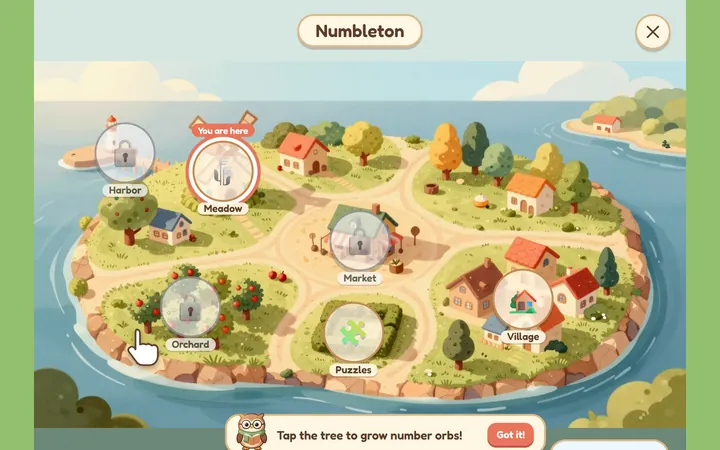
  • Numbleton

    Ages 7 to 9

    Merge blocks, fill the villagers' orders, bring the numbers home.

    Tap the tree, drag blocks together: ten ones make a ten, ten tens make a hundred. Every order is a sum, a times fact, a clock or a coin count, and each island adds a season of story.

    They practice

    • Place value to 1,000
    • Adding with regrouping
    • Times tables
    • Telling time
    • Area and rows
    • Money
    • Fractions
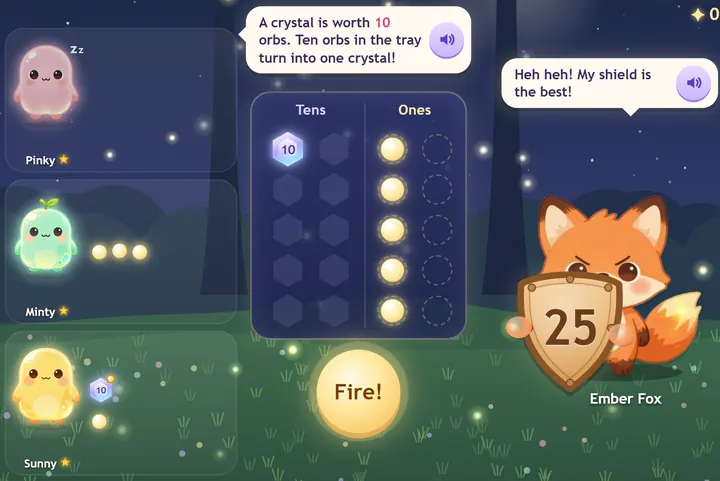
  • Orb Spirits

    Ages 8 to 11

    Build the number, break the shield, make a friend.

    A creature-collecting adventure. Drag glowing orbs into the tray, match the monster's shield exactly, and the beaten monster joins your team. Three Books, one grade each, more than 80 spirits.

    They practice

    • Place value to a million
    • All four operations
    • Fractions and decimals
    • Time and measurement
    • Area, angles, volume
    • Coordinates
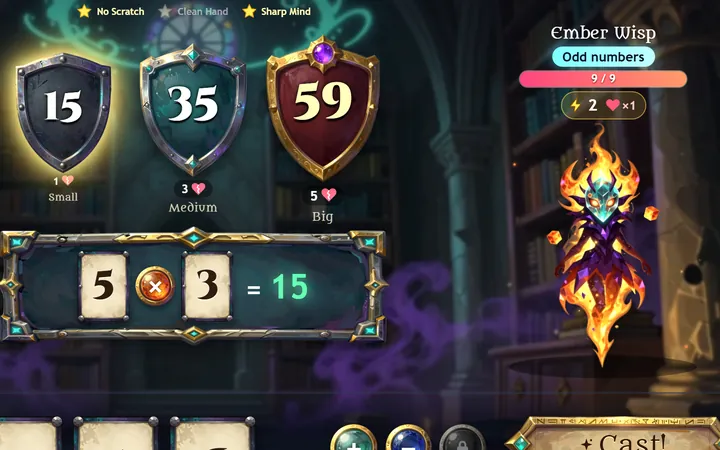
  • Mathmancer

    Ages 9 to 13

    Build spells from number cards. Climb the tower.

    A card battler for kids who want to think. Combine the cards in hand with + − × ÷ and brackets to hit the shield's number exactly, collect cards and charms, and face a boss every few floors.

    They practice

    • Mental arithmetic
    • Times tables to 12 × 12
    • Order of operations
    • Brackets
    • Factors, multiples, primes
  • More on the way

    What should the next one teach?

    We build about one game a month, each for one stretch of school math. Tell us where your kid gets stuck and we'll put it on the list.

Which one first?

Pick by what they are learning.

  • Ages 7 to 9

    Just starting with tens and hundreds

    Numbleton turns ones into tens and tens into hundreds, one merge at a time, with the times tables along the way.

    Numbleton
  • Ages 8 to 11

    In grade 3 to 5 and loves collecting

    Orb Spirits follows one grade per Book, the whole year of math, with more than 80 spirits to befriend.

    Orb Spirits
  • Ages 9 to 13

    Knows the times tables and wants a fight

    Mathmancer is a card battler where brackets, factors and planning win. A climb takes 30 to 45 minutes.

    Mathmancer

For middle school · Grades 6 to 8

Getting ready for a math contest?

Not a game this time: practice for students in grades 6 to 8 who are going for top scores on the AMC 8 or at MATHCOUNTS.

AMC 8 Prep

Grades 6 to 8

Fresh contest problems, worked solutions, real past papers.

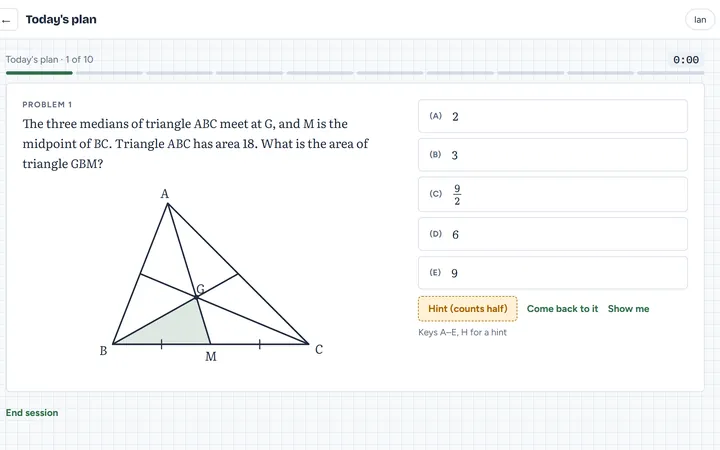
Endless AMC 8-style problems, each with a drawn figure where it needs one and a worked solution. The next problem adapts to the student's level, missed problems come back, practice tests lay out 25 new problems like a real paper, and an answer sheet scores the real past papers against each year's top 5% and top 1% cutoffs.

Every area of the contest

  • Arithmetic
  • Algebra
  • Counting & probability
  • Number theory
  • Geometry
  • Ratios & rates
  • Statistics
  • Logic & patterns

AMC is a trademark of the MAA. Not affiliated with the MAA.
MATHCOUNTS Prep

Grades 6 to 8

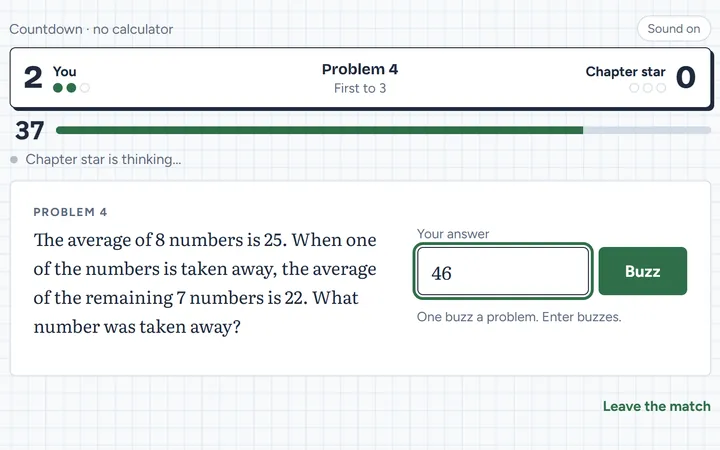
Typed answers, timed rounds, and Countdown duels.

MATHCOUNTS-style problems with typed answers, checked the contest's way: the right number in the form the problem asks for, with a note when a wrong answer comes from a common slip. Timed Sprint and Target rounds, and Countdown duels against a computer opponent.

Every area of the contest

  • Arithmetic
  • Algebra
  • Counting & probability
  • Number theory
  • Geometry
  • Ratios & rates
  • Statistics
  • Logic & patterns

MATHCOUNTS® is a registered trademark of the MATHCOUNTS Foundation. Not affiliated with or endorsed by the MATHCOUNTS Foundation.

For parents

Made for kids. Built for parents' peace of mind.

Every line in Numbleton and Orb Spirits is spoken aloud, so early readers can play on their own. Each game has its own page for parents that says what it practices and what it keeps.

  • No ads. Ever.

    Not in the games, not on this page.

  • No coins, loot boxes or upsells aimed at kids.

    Anything a grown-up should decide sits behind a grown-ups check.

  • No personal data from children.

    Progress stays on your device. A family account is optional.

Our story

I built Orb Spirits for my 8-year-old daughter. She loved creature games and didn't love math worksheets, so I made the math the thing you do to play. Numbleton came next, for kids just starting with tens, and Mathmancer for the older ones who wanted a real fight. Every level has been playtested at our kitchen table, and they still ask for one more.

— A parent

Where to play

Right in your browser.

All three games play in any modern browser on a computer or tablet, with nothing to install, and we keep adding to them. Apps for iPad and iPhone come later.

Progress is saved on your device. A family account is optional and carries it to another device.

Tell us

Tell us what you think.

A level that's too hard, a bug, an idea, a word your kid loved. One box, and an email only if you'd like an answer.

For grown-ups. We read every one. See our privacy page.

FAQ

Questions parents ask

Which game should we start with?

Numbleton if your child is just getting comfortable with tens and hundreds (about ages 7 to 9). Orb Spirits for grades 3 to 5, one Book per grade. Mathmancer once the times tables are solid and they want a real challenge (ages 9 to 13). Many kids play two.

Does my child need to read well?

Not for Numbleton or Orb Spirits: every line is spoken aloud, and tutorials show each step with a pointing hand. Mathmancer has more reading and uses your browser's own voice.

What devices does it run on?

Any modern browser on a computer or tablet. Mathmancer also plays upright on a phone. Apps for iPad and iPhone are coming.

What data do you collect?

Nothing personal from children. The games save progress on your device. Our pages use a page counter from our host, Cloudflare, that sets no cookies, and the games send anonymous counts like "level won" or "lesson finished" with no cookies and no identifiers, so we can see where they get hard.

Can teachers use it in class?

Yes, all three work in any classroom browser. Classroom features are on our list; write to us.

How is it different from other math apps?

Most put a quiz in front of a game. Here the math is the game: you win by merging the right blocks, building the right number or casting the right spell, not by answering a question to earn a turn.